
Compare iPhone Models by Battery, Camera, and Value
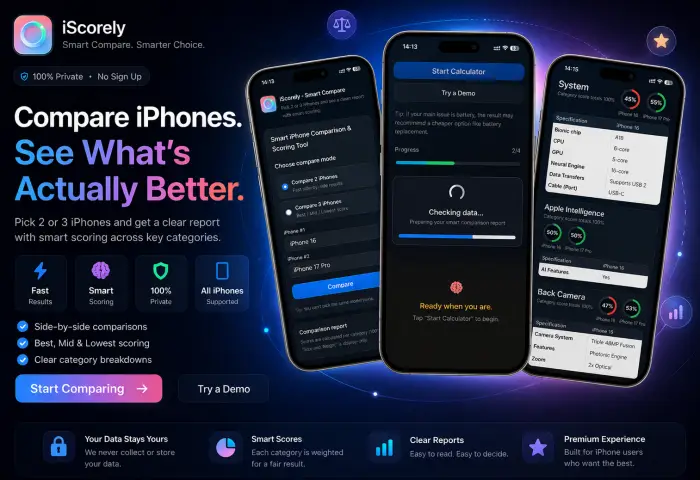
Not sure which iPhone actually makes the most sense for your needs? Compare battery, camera, value, and real everyday benefit before you buy.
Most iPhone comparison pages show long spec lists and still leave you doing the hard part alone. This page takes a simpler approach.
Instead of comparing everything equally, it helps you focus on the parts most buyers actually care about: battery life, camera quality, value for the money, and whether the upgrade is worth it at all.
The Real Question Is Not Which iPhone Has More Specs
A lot of people open comparison pages expecting a clear answer. Instead, they end up with too many tabs, too many numbers, and no real confidence about which iPhone to buy.
🚀 The real question is which iPhone is better for you
The best iPhone on paper is not always the best iPhone for your daily life.
Some people care most about battery life. Others want a better camera. Others just want the best value without overspending. That is why the right comparison should start with your needs, not with a giant wall of specs.
🚀 Most comparison pages show data, not direction
Specs are useful, but they do not always help with the final decision.
A comparison page can show chip names, screen sizes, and technical details all day long and still fail to answer the simple question: Which iPhone should I actually buy?
🚀 Battery, camera, and value usually matter more than most spec lines
For most buyers, the real decision comes down to a few things:
- how long the battery lasts in daily use
- whether the camera improvement is worth paying for
- whether the extra money brings enough real benefit
- whether the upgrade feels meaningful, not just newer
That is why this page focuses on battery, camera, and value first. Those are usually the areas that make the biggest difference in real use.
A Simpler Way to Compare iPhone Models
You do not need to compare every detail equally. A better way is to compare the things that actually change how the phone feels to use every day.
Start with these four areas.
1. Start with battery, not just chip names
Many buyers start with performance because it sounds important. In daily life, battery often matters more.
👉 Daily battery confidence
A phone that feels dependable from morning to night usually matters more than a small performance jump you barely notice.
👉 Real-world battery usefulness
Think about how the iPhone fits your actual routine. If you are out all day, traveling often, using navigation, filming, or working from your phone, battery can matter more than many headline specs.
👉 Battery value for long days
A higher-priced model only makes sense if the battery improvement actually changes your daily experience. That is the kind of comparison worth focusing on.
2. Compare the camera for how you actually use it
Not every camera upgrade is worth paying for.
👉 Photo quality
If you take a lot of everyday photos, family pictures, product shots, or travel images, camera quality can be a major decision point.
👉 Video value
For some users, video matters as much as photos. If video is a real part of how you use your phone, compare that upgrade in practical terms, not just feature names.
👉 Whether the camera jump is worth paying for
A better camera only matters if you will actually feel the improvement. That is the better question to ask before spending more.
3. Judge value, not just the newest model
Newer does not always mean smarter.
👉 Price vs benefit
If one iPhone costs more, the improvement should feel worth the extra money. If it does not, the better value may be the lower-priced model.
👉 Trade-offs between tiers
Sometimes the choice is not between “good” and “bad.” It is between “very good” and “good enough for much less.” That is where value matters most.
👉 Best value for your money
The best value iPhone is the one that gives you the strongest mix of daily usefulness and price, not just the biggest spec sheet.
4. Ask whether the upgrade is meaningful
This is one of the most important parts of the whole decision.
👉 Current iPhone vs possible upgrade
If you already have an iPhone, compare the upgrade against what you use now, not just against marketing claims.
👉 Better on paper vs better in real life
A new phone can look much better in a chart and still feel only slightly better in daily use. That is why the comparison should stay practical.
👉 What actually changes daily use
The strongest upgrade is the one that improves the parts of the experience you notice often:
- battery confidence
- camera results
- storage comfort
- speed that feels smoother
- overall value that feels justified
That is how to compare iPhone models in a way that actually helps you buy smarter.
What Matters Most in an iPhone Comparison
A good iPhone comparison should help you buy with more confidence, not leave you buried in technical detail. Most buyers do not need every spec explained equally. They need to know which parts of the phone will matter most in real daily use.
👉 Battery
Battery matters because it changes how dependable the phone feels from morning to night. If you are always out, traveling, filming, using maps, or working from your phone, battery can shape your whole experience more than small technical differences elsewhere.
👉 Camera
Camera matters when you actually care about the quality of the photos and videos you take every week. The important question is not whether one model has more camera features. It is whether the camera upgrade feels meaningful for how you really use your iPhone.
👉 Value
Value matters because the most expensive iPhone is not always the smartest buy. A better value model can often give you most of what you need without making you pay extra for gains you may barely notice.
👉 Performance
Performance matters when you want the phone to feel smooth, fast, and reliable for your normal apps and daily tasks. But it should still be judged in real-world terms, not just by newer chip names alone.
👉 Display
Display matters more for some users than others. If you watch a lot of video, edit content, play games, or simply care about how the phone looks and feels every day, display becomes a bigger part of the comparison.
👉 Upgrade worth
This may be the most important category of all. A phone can be better on paper and still not be worth buying for your situation. The real question is whether the upgrade feels meaningful enough to justify the money.
When Battery Should Lead the Decision
For many buyers, battery is the first thing that should shape the choice.
» You need stronger all-day use
If your phone has to carry you through work, travel, navigation, camera use, messaging, and everything else without constant charging, battery should be one of the first comparison points.
That is especially true if weak battery life creates daily stress, not just occasional inconvenience.
» Battery life matters more than small spec jumps
A slightly faster chip or a few extra features may not change your day much. Better battery life often does.
If the phone is going to be used heavily, battery can matter more than the type of upgrade that sounds impressive but feels small in real use.
» The best battery iPhone is not always the most expensive one
This is where people often overspend.
Sometimes the best battery choice is not the top-tier iPhone. It may be the model that gives you the strongest battery benefit for the price you are actually comfortable paying.
If battery is your main concern, it also makes sense to check whether your current phone’s battery is still worth keeping before moving straight into upgrade mode. That is where BattScope can help.
When Camera Should Lead the Decision
For some buyers, camera quality is the real reason the comparison matters.
👉 You actually care about the camera in daily use
If you regularly take family photos, social media content, product images, travel shots, or videos, camera differences can matter a lot more than general comparison pages admit.
In that case, the camera should not be treated like a side detail. It should be one of the main reasons behind the final decision.
👉 Not every camera upgrade feels worth the price
A better camera on paper does not always mean a better camera upgrade for you.
The key question is whether the improvement is strong enough to change how your photos or videos actually look in the situations you care about most.
👉 The right question is whether the camera change matters to you
This is what many comparisons miss.
If you only take simple everyday photos, a major camera upgrade may not bring enough value to justify paying much more. If the camera is central to how you use your phone, the same upgrade may be worth every extra dollar.
That is why camera should lead the decision only when camera quality truly matters to your day-to-day use.
When Value Should Lead the Decision
For many buyers, value is the most useful comparison lens of all.
👉 The newest iPhone is not always the smartest buy
A newer iPhone may be better in several ways, but that does not automatically make it the better purchase.
If the real benefit feels small compared with the price jump, the smarter move may be the phone that gives you more of what you need for less money.
👉 Best value depends on what you are paying for
Value is not about finding the cheapest iPhone. It is about understanding what you are getting for the price.
A strong-value choice gives you enough battery, enough camera quality, enough performance, and enough daily comfort without pushing you to spend more than the improvement is worth.
👉 A higher price only makes sense if the daily benefit is real
This is the question that keeps the comparison honest.
If the more expensive model clearly improves the parts of the iPhone experience you care about most, the extra cost may be justified. If those improvements feel minor in real life, the higher price may not make sense.
That is why value often gives the clearest answer. It cuts through the hype and brings the decision back to real daily benefit.
Compare 2 or 3 iPhones Without Getting Lost
This is where a lot of buyers get stuck. Two tabs turn into five, one model turns into three, and the decision gets less clear instead of more useful.
A better comparison should make the choice easier to act on, not harder to hold in your head.
🚀 Why 2-model comparisons are easier to act on
When you are choosing between two iPhones, the decision usually becomes simpler and more practical.
You can focus on the real trade-off:
- better battery or better value
- better camera or lower cost
- newer model or smarter buy
That kind of comparison is easier to finish because the differences stay clearer.
🚀 When a 3-model comparison helps
A 3-model comparison makes sense when your decision is wider and you are still narrowing the field.
This is useful when:
- you are comparing your current iPhone with two upgrade options
- you want to see whether the middle option gives the best value
- you are trying to avoid overpaying for a top model you may not need
Three-way comparison can be powerful, but only if it stays organized around what matters most.
🚀 Why category winners make the choice clearer
This is one of the easiest ways to reduce comparison overload.
Instead of trying to judge everything at once, category winners help show:
- which iPhone is stronger for battery
- which is better for camera
- which gives better value
- which performs better overall
That makes the final decision feel more useful because you can see where each phone actually stands instead of trying to balance a long list of raw specs on your own.
A Better Way to Compare: Use iScorely
If you want a cleaner way to compare iPhone models by battery, camera, and value, this is where iScorely fits.
It is built for people who want to compare 2 or 3 iPhones without getting buried in tabs, spec overload, or vague conclusions.
1. Why iScorely fits this problem well
iScorely fits this comparison problem because it focuses on the areas buyers usually care about most. Instead of making you do all the interpretation yourself, it helps turn the comparison into something easier to understand and easier to use.
That makes it a better fit for real buying decisions, not just technical browsing.
2. What iScorely compares
👉 Battery
See which iPhone gives the stronger battery advantage for daily use.
👉 Camera
Compare camera strength more clearly for the way you actually use your phone.
👉 Display
Look at display quality in a way that feels useful, not overbuilt.
👉 CPU and chipset
Understand the performance side without needing to turn the decision into a chip-spec research project.
👉 Performance
See how the phones compare for speed, smoothness, and everyday use.
👉 Value and more
Compare what you are paying against what you are really getting.
3. Why category scores help more than raw spec walls
Raw specifications can tell you what changed, but they do not always tell you what matters.
Category scores make the decision easier because they show where each iPhone is stronger and where the differences may actually affect your daily experience. That is much easier to act on than trying to sort through long lists of technical details on your own.
4. When iScorely is better than jumping between tabs
iScorely is the better move when:
- you are comparing 2 or 3 iPhones at once
- you want clearer answers by battery, camera, and value
- you are tired of bouncing between spec tables and still feeling unsure
- you want to make the comparison faster without making it shallow
If that sounds like your situation, iScorely fits the job well.
Which Comparison Path Fits You Best?
Not every buyer starts in the same place. Some people care most about battery life. Others are really deciding whether the upgrade is worth the money at all.
This is the easiest way to choose the right next page or tool.
👉 If battery life matters most
If battery confidence is the main thing shaping your decision, start there first.
A strong battery can matter more than small spec differences, especially if you use your iPhone heavily all day. If you are also wondering whether your current iPhone battery is still worth keeping, read Battery Replacement or New iPhone? first, or use BattScope to get a clearer battery-focused view before comparing upgrades.
👉 If you are deciding whether to upgrade or wait
If the main question is timing, the better path is not just comparison. It is deciding whether the jump is actually worth making now.
That is where Upgradey fits best. For the full decision guide, go to Should I Upgrade My iPhone or Wait? and compare cost, trade-in value, battery condition, and real everyday benefit.
👉 If value matters more than hype
If you care more about getting the smartest buy than chasing the newest model, iScorely is the stronger fit.
It helps compare iPhones by battery, camera, value, and category scores so the decision feels more grounded. If you want the full tool set in one place, this is also where iPrimer becomes useful.
👉 If you want a cleaner set of iPhone decision tools
If your decision is bigger than just one comparison and you want help with subscriptions, battery, upgrade timing, and iPhone comparison in one system, go to Best iPhone Productivity Tools for Daily Decisions.
That page helps you see how the main tools fit together instead of solving each problem separately.
Examples That Make the Comparison Easier
Real decisions are usually easier to understand through examples than through generic advice.
Example 1: You want the best battery for daily use
You are out for long hours, use your phone heavily, and care more about dependability than small technical upgrades.
In that case, battery should lead the comparison. The right choice is the iPhone that gives stronger daily confidence, not just the one with the newest hardware language.
Example 2: You want the best camera jump for the money
You care about photos and videos, but you do not want to overpay just for a camera improvement that feels small in real life.
This is where camera and value should be judged together. A more expensive iPhone is only worth it if the camera jump actually changes the quality you care about.
Example 3: You are choosing between two strong options
Sometimes both phones are good enough, which is exactly why the decision becomes harder.
This is where category comparison matters most. Instead of asking which phone is “best” in general, ask which one is better for battery, camera, and value for your needs.
Example 4: You are deciding whether your current iPhone is still enough
This is not only a comparison question. It is also an upgrade-worth-it question.
If your current phone still feels good enough, the smarter move may be waiting. If the new iPhone clearly improves the parts of daily use you notice most, the upgrade may finally make sense.
Why You Can Trust This Comparison Process
A useful comparison should help you buy with more confidence, not overwhelm you with more information than you need.
This page is built to support the actual decision, not just display specs.
» Built around buying decisions, not just specs
The comparison starts with the real question: which iPhone is better for your use, your budget, and your upgrade timing?
That is more useful than treating every technical difference like it matters equally.
» Focused on battery, camera, value, and real use
These are the areas that shape most iPhone buying decisions. They are also the parts most likely to make the daily experience feel better or make a higher price feel justified.
» The goal is the clearer choice, not the bigger number
A bigger number on a comparison sheet does not always mean a better buying decision.
The point of this comparison process is to make the choice easier to trust, not just to show which phone looks strongest on paper.
» Not every user needs the most expensive iPhone
For many buyers, the smarter decision is not the newest or most expensive iPhone. It is the one that gives the right balance of battery, camera, performance, and value for how they actually use the phone.
Related Pages That Can Help Next
If you want to go deeper into the decision, these Layer 2 pages can help.
👉 Should I Upgrade My iPhone or Wait?
If the bigger question is timing, this page helps you compare cost, battery condition, trade-in value, and real daily benefit before you buy.
👉 Battery Replacement or New iPhone?
If battery is the issue and you are not sure whether to repair your current phone or replace it, this guide helps you compare both paths more clearly.
👉 Best iPhone Productivity Tools for Daily Decisions
If you want a cleaner system for battery, upgrade, subscription, and comparison decisions, this page shows how the main tools work together.
👉 Best Subscription Tracker for iPhone
If subscription costs are also part of your budget pressure and buying decisions, this page helps you find a privacy-first, reminder-first tracking solution that fits iPhone users better.
These pages work well together because they help answer the next question naturally instead of forcing one rushed decision.
FAQ in 2026
1. What is the best way to compare iPhone models?
The best way to compare iPhone models is to start with the parts that actually change daily use: battery life, camera quality, value for the money, and whether the upgrade feels worth it. That gives you a clearer answer than treating every spec as equally important.
2. Should I compare iPhone models by battery, camera, and value first?
Yes. For most buyers, those are the three areas that matter most. Battery affects daily confidence, camera affects real-world photos and videos, and value helps you decide whether the higher price is actually justified.
3. Which matters more when comparing iPhones: battery, camera, or performance?
That depends on how you use your iPhone. Battery matters most if you need strong all-day use. Camera matters most if photos and videos are a major reason to upgrade. Performance matters most if your current phone already feels slow or limited.
4. How do I know which iPhone gives the best value?
The best value iPhone is not always the newest or most expensive one. It is the model that gives you the strongest mix of battery, camera, performance, and everyday usefulness for the price you are comfortable paying.
5. Is the most expensive iPhone always the best one to buy?
No. A more expensive iPhone only makes sense if the extra cost brings meaningful daily benefit. If the improvement feels small for your needs, a lower-priced model may be the smarter choice.
6. Can I compare 2 or 3 iPhones at once?
Yes. Comparing 2 or 3 iPhones at once can make the decision clearer, especially when you want to see which model wins in battery, camera, value, and performance. This is often more useful than jumping between multiple tabs and trying to remember differences.
7. What should I check first when comparing my current iPhone to a new one?
Start with the parts you will actually notice:
- battery life
- camera improvement
- storage comfort
- performance in daily use
- whether the total value feels worth the cost
That makes the comparison more practical and less overwhelming.
8. How do I know if an iPhone upgrade is actually worth it?
An upgrade is usually worth it when the new iPhone improves the parts of daily use that matter most to you and the cost feels justified. If the new model only looks slightly better on paper, waiting may be the smarter move.
9. Should I compare my current iPhone with a new model before upgrading?
Yes. That is one of the smartest ways to avoid a weak upgrade. Comparing your current iPhone against the model you want helps you see whether the battery, camera, value, and overall jump really feel meaningful.
10. Is battery life more important than small spec differences?
For many buyers, yes. A phone that lasts longer and feels more dependable every day often matters more than small technical changes that are harder to notice in real use.
11. Does camera quality always make the more expensive iPhone worth it?
No. A camera upgrade is only worth paying for if it changes the kind of photos or videos you care about. If your current camera already works well for your needs, the extra price may not feel justified.
12. What makes iScorely useful for comparing iPhones?
iScorely helps compare 2 or 3 iPhones by battery, camera, display, CPU, chipset, performance, and value with clearer category scores. That makes it easier to see which iPhone is better in each area instead of getting lost in long raw spec tables.
13. Is iScorely better than reading spec tables alone?
For many buyers, yes. Raw spec tables show data, but they do not always show what matters most. iScorely is more useful when you want a clearer comparison with category scores and a simpler buying decision.
14. Can iScorely help me compare iPhones by battery, camera, and value?
Yes. That is one of its main strengths. It is built to help users compare iPhones in the areas buyers usually care about most, then turn those differences into a clearer decision.
15. What should I do next if I am still unsure which iPhone is right for me?
Start with the comparison path that matches your problem best. If battery matters most, check battery-focused guidance first. If upgrade timing is the real issue, use an upgrade decision tool. If you want a clearer side-by-side answer, compare iPhones with iScorely.